

Introduction
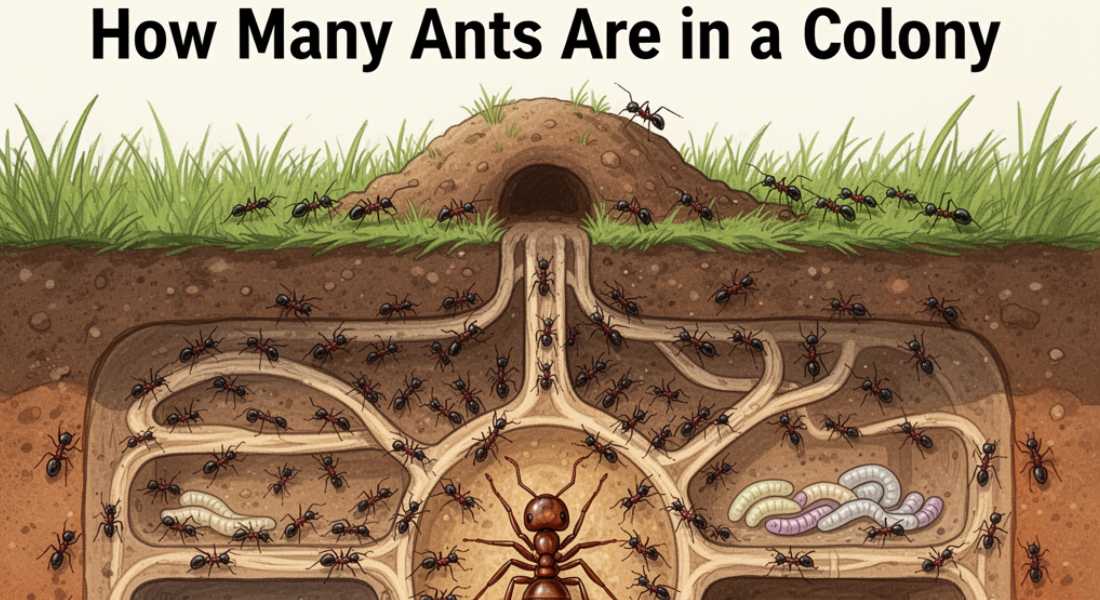
How many ants are in a colony varies dramatically depending on the species, ranging from just a few dozen individuals to over 20 million members in supercolonies. Understanding colony populations helps us appreciate these remarkable insects that outnumber humans by a staggering ratio.
This comprehensive guide explores everything from small household ant nests to massive underground empires, revealing the fascinating social structures and population dynamics that make ant colonies some of nature’s most successful communities.
Understanding Ant Colony Populations
Ant colonies represent one of nature’s most organized social systems. The population size depends on multiple factors including species, age of the colony, environmental conditions, and available resources.
A newly established colony starts with just a single queen ant and grows over time. Some species maintain modest populations throughout their existence, while others develop into sprawling metropolises beneath our feet.
Small Colony Species
Sugar ants typically form colonies containing 1,000 to 15,000 workers. These tiny sugar ants often invade homes seeking food sources, particularly sweet substances. A sugar ant colony can fit entirely within wall voids or small outdoor spaces, making them common household visitors.
Carpenter ants maintain moderate populations ranging from 2,000 to 10,000 individuals. Despite their smaller numbers compared to some species, they can cause significant structural damage to wooden buildings.
Pavement ants usually have colonies with 3,000 to 10,000 workers. These are the common ants you see creating small mounds in sidewalk cracks.
Medium Colony Species
Odorous house ants build colonies containing 10,000 to 100,000 members. These adaptable insects frequently establish multiple nesting sites connected by trails, effectively creating a network of interconnected populations.
Harvester ants develop mature colonies with 10,000 to 50,000 workers. These industrious insects collect and store seeds, creating impressive underground granaries.
Large Colony Species
Fire ants create some of the most populous single colonies, with mature nests housing 100,000 to 500,000 workers.
Queen fire ants are exceptionally productive, laying thousands of eggs daily. Some established fire ant colonies can contain multiple queen fire ants, dramatically increasing population capacity.
Leafcutter ants form massive underground cities containing 1 to 8 million individuals. Their complex societies include specialized workers that cut leaves, maintain fungus gardens, and defend the colony.
Argentine ants hold the record for creating supercolonies. A single interconnected supercolony can span thousands of kilometers and contain billions of individuals across millions of nesting sites.
The Queen Ant’s Role in Colony Size
The queen of ants serves as the reproductive center of every colony. A queen ant can live 15 to 30 years depending on the species, continuously producing offspring throughout her life.
Queen ant size typically exceeds worker ants significantly. She measures 2 to 4 times larger than workers, with a robust thorax designed to support her reproductive organs.
What does a queen ant look like varies by species, but most feature a larger abdomen, visible wing scars from their mating flight, and a distinctly different body structure compared to workers.
A single queen ant might lay 800 to 1,500 eggs daily in highly productive species. This reproductive capacity directly determines how quickly a colony grows and its maximum population potential.
Some species practice polygyny, where multiple queen ants coexist in one colony. This arrangement can exponentially increase population growth rates and colony resilience.
Colony Structure and Worker Distribution
Understanding the types of ants in a colony reveals how populations organize themselves efficiently. Every colony divides labor among specialized castes.
Worker Castes
Major workers or soldiers represent the largest workers, typically comprising 5 to 10 percent of the population. These individuals defend the colony and handle tough tasks like breaking down large food items.
Minor workers make up the majority of any colony, performing essential tasks like foraging, brood care, and nest maintenance. Their numbers directly influence colony success.
Media workers serve as intermediate specialists in some species, bridging the gap between major and minor workers with versatile abilities.
Jobs of Ants Within Colonies
The jobs of ants distribute across numerous specialized roles. Nurse ants care for eggs and larvae. Foragers venture outside to collect food. Guards protect entrances from intruders. Maintenance workers repair and expand nest structures.
This division of labor allows colonies to function with remarkable efficiency despite containing thousands or millions of individuals who never receive direct instructions.
Types of Ants and Their Colony Sizes
Different types of ants create vastly different population structures based on their evolutionary adaptations and ecological niches.
Common House Ant Species
Types of house ants encountered indoors typically form smaller colonies adapted to exploiting human structures. Types of ants in house environments include sugar ants, odorous house ants, pharaoh ants, and carpenter ants.
Sugar ant nests often contain 1,000 to 5,000 workers in residential settings. Where do sugar ants come from? They typically establish outdoor colonies and send foraging parties indoors when they detect food sources.
What are sugar ants exactly? This common name actually refers to several small ant species attracted to sweet foods, most commonly odorous house ants or pharaoh ants in North America.
Fire Ant Colonies
Where do fire ants live? These aggressive insects thrive in warm climates, particularly across the southern United States, South America, and parts of Asia and Australia. Their colonies build distinctive mound structures in open sunny areas.
Fire ant populations grow rapidly under favorable conditions. How many fire ants are in a colony at maturity? Established single-queen colonies typically contain 100,000 to 250,000 workers, while multiple-queen colonies can exceed 500,000 individuals.
Sugar Ant Populations
How many sugar ants are in a colony depends on the specific species and environmental conditions. Most sugar ants colony populations range from 1,000 to 15,000 workers in typical nesting sites.
These adaptable insects can establish satellite colonies, creating interconnected population networks that effectively increase their total numbers while maintaining smaller individual nest populations.
The Global Ant Population
How many ants on earth exist? Scientists estimate approximately 20 quadrillion ants inhabit our planet. This staggering figure represents roughly 2.5 million ants for every human being.
How many ants are in the world today? Current research published in 2022 calculated the total biomass of all ants on earth equals approximately 12 megatons of dry carbon. This exceeds the combined biomass of all wild birds and mammals.
The number of ants on earth distributes unevenly across ecosystems. Tropical regions support the highest diversity and density of ant populations, while some species thrive in temperate and even arctic environments.
How many ants are there across different habitats? Rainforests might contain 3 to 7 million ants per acre, while temperate forests typically support 1 to 3 million per acre. Even urban environments maintain surprisingly robust populations.
Factors Affecting Colony Population
Several critical factors determine how many ants can be in a colony at any given time.
Climate significantly impacts colony growth rates. Warmer temperatures generally accelerate development and increase reproductive output, explaining why tropical species often form larger colonies than temperate relatives.
Food availability directly limits population size. Colonies cannot grow beyond what their foraging range can sustainably support. Rich food sources near nesting sites enable rapid population expansion.
Predation and competition from other colonies creates natural population checks. Aggressive neighboring colonies may raid nests, reducing populations or eliminating entire colonies.
Nest space constrains physical population limits. Underground colonies require suitable soil for expansion, while species nesting in wood face structural limitations.
Disease and parasites can devastate colonies. Fungal infections, parasitic flies, and other pathogens sometimes wipe out entire populations.
Remarkable Ant Abilities
Understanding ant capabilities helps explain their evolutionary success despite individual fragility.
Strength and Carrying Capacity
How much can an ant lift? Individual workers can carry 10 to 50 times their body weight depending on species. Some exceptional species like leafcutter ants can carry loads up to 50 times their weight using their powerful mandibles.
How much weight can an ant carry over distance? While short-distance lifting capacity impresses, ants typically carry 5 to 20 times their body weight during normal foraging activities to maintain sustainable speeds.
Size and Weight
How much does an ant weigh on average? Most common ant species weigh between 1 and 5 milligrams. How much do ants weigh across different species varies considerably. Tiny species might weigh just 0.1 milligrams, while large carpenter ant workers can reach 10 milligrams.
How much does one ant weigh compared to other insects? Ants rank among smaller insects, but their collective biomass far exceeds most other invertebrate groups due to their enormous populations.
Weight of an ant might seem insignificant individually, but when multiplied across colony populations, the collective mass becomes substantial. A large fire ant colony weighing several kilograms demonstrates the cumulative power of colonial organization.
Colony Life Cycle and Growth
New colonies begin when winged reproductive ants participate in mating flights. After mating, the fertilized queen ant sheds her wings and seeks a suitable nesting site.
Initially, a founding queen lives off her wing muscle reserves while producing the first generation of workers. This pioneer phase lasts several months, during which the queen single-handedly cares for her brood.
Once the first workers emerge, they assume foraging and maintenance duties. The colony enters an establishment phase of exponential growth lasting 3 to 5 years for most species.
Mature colonies reach stable population sizes determined by environmental carrying capacity. Some species maintain populations for decades, while others cycle through boom and bust periods seasonally.
Types of Ant Colonies
What types of ants are there in terms of social organization? Most species form standard colonies with a single queen, but variations exist.
Monogynous colonies contain one queen and represent the most common structure. These colonies typically show clear population limits based on that single queen’s reproductive capacity.
Polygynous colonies house multiple queens working cooperatively. This arrangement enables much larger populations and greater resilience since losing one queen doesn’t doom the colony.
Supercolonies represent interconnected networks spanning vast distances. Argentine ants and red imported fire ants sometimes form these mega-structures containing billions of individuals across thousands of nesting sites.
Temporary social parasites involve queen ants invading other species’ colonies and exploiting their workers until her own offspring replace the host population.
FAQs
How many ants live in a colony on average?
Most ant colonies contain between 10,000 and 500,000 workers depending on species. Small species like some sugar ants might have just 1,000 individuals, while fire ants commonly reach 100,000 to 250,000 workers in mature nests. Large species such as leafcutter ants can create colonies with several million members.
How many ants in one colony is considered large?
Colonies exceeding 100,000 workers are generally considered large. Fire ant colonies with 250,000 individuals, leafcutter colonies with millions of workers, and Argentine ant supercolonies with billions of interconnected individuals represent the upper extremes of colonial populations.
How much ants are in a colony when it first starts?
New colonies begin with just a single queen ant. She produces the first generation of 5 to 20 workers alone. Within the first year, populations typically grow to several hundred individuals. Full maturity requiring 3 to 5 years brings colonies to their species-specific maximum population.
What determines how many ants are usually in a colony?
Species genetics sets the baseline potential, but environmental factors ultimately determine actual populations. Food availability, nest space, climate, predation pressure, and the queen’s reproductive capacity all influence final colony size. Multiple-queen colonies naturally support larger populations than single-queen nests.
How many ants are there in the world compared to colony sizes?
Scientists estimate 20 quadrillion ants inhabit Earth across approximately 20,000 species. This massive global population distributes across countless individual colonies of varying sizes. Even accounting for enormous supercolonies, the vast majority of this population lives in moderate-sized colonies of 10,000 to 500,000 individuals.
Can you identify a queen ant in a colony?
Yes, queen ants have distinctive features. They measure significantly larger than workers, possess a more robust thorax, display wing scars from their mating flight, and have proportionally larger abdomens for egg production. In active colonies, queens typically remain deep in protected chambers surrounded by attendant workers.
Conclusion
The question of how many ants are in a colony reveals the incredible diversity of these social insects. From modest sugar ant nests with a few thousand members to fire ant colonies approaching half a million workers, population sizes reflect each species’ unique evolutionary strategy.
Understanding colony populations helps us appreciate both the individual colonies we encounter and the staggering global population of ants sharing our planet. Whether dealing with household invaders or marveling at nature’s complexity, recognizing the scale of ant societies deepens our respect for these tiny but tremendously successful organisms.
Next time you spot an ant trail, remember that each worker represents just one member of a vast underground community working together with remarkable coordination and efficiency.